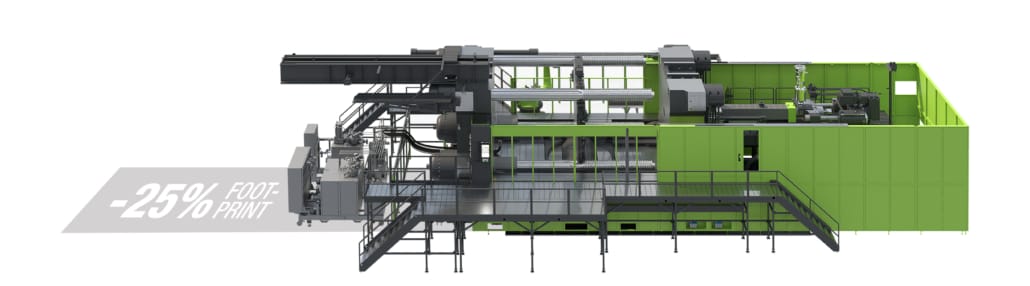
ENGEL makes clearmelt systems more flexible and more cost-effective: New machine concept reduces investment costs, footprint and complexity
ENGEL has developed a new machine concept for clearmelt systems based on the duo combi M two-platen injection moulding machine in order to make the clearmelt process even more efficient and easier to implement. The clearmelt technology itself has been established in series production for many years: plastic components are flooded in the mould with a transparent or coloured polyurethane layer and thereby receive high-quality, scratch-resistant surfaces directly in the injection moulding process, including the integration of functional films. Downstream painting or coating processes can be replaced in many applications. The new machine concept enables shorter PUR feed lines and thus saves considerable costs. In addition, its use becomes more flexible. For processors, this reduces the effort required for installation, operation and maintenance.
With clearmelt technology, decoration, protective function and component geometry can be combined in a highly integrated process. The process continues to gain importance in the automotive industry. New vehicle concepts call for larger, high-quality designed and at the same time robust interior and exterior components.
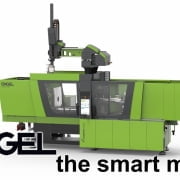
In the new machine concept, the thermoplastic component is injected via the injection unit on the moving side of the machine. The technical basis is formed by the combi M design of the ENGEL duo two-platen injection moulding machines. In the new design, the standard injection unit on the side of the fixed platen is omitted. In its place, the polyurethane equipment is positioned. The thermoplastic component is injected from the moving side of the machine, while the PUR mixing head is arranged on the fixed platen. As a result, the PUR technology sits closer to the mould, the PUR feed lines become shorter, and the system periphery becomes more compact, easier to handle, faster to convert and more cost-effective to operate.
For users, this new arrangement means above all considerably shorter line routes for the polyurethane. Since the PUR equipment is located directly at the fixed platen, flow paths and line volumes can be substantially reduced, which considerably lowers the investment effort. The installation effort also decreases significantly, because no expensive piping has to be laid. This effect is particularly important when investing in multi-colour applications, as a separate pipe would be required here for each individual colour to be produced. This reduces the investment costs for a clearmelt system. These lines can now be designed to be much shorter and moving hoses are not used. Hose connections only have to be briefly disconnected when changing the PUR equipment.
The new system concept is available in a mirrored version. This positions the injection unit so that the material supply remains on the customary side and fits seamlessly into the processor’s existing in-plant logistics. Additional modifications in the production environment are not required.
Colour change in less than 10 minutes
The new system concept also enables more flexible use of the colour units. In the previous configuration, these were permanently assigned to one machine. Previously, unused colour lines had to circulate permanently to prevent colour particles and additives from settling. This is now no longer necessary. Flushing processes for the lines in order to disconnect the colour units from the production cell are completely eliminated.
This enables colour change in less than 10 minutes. Operators can therefore distribute the units across several systems more in line with demand, reduce downtimes and utilise existing resources more efficiently.
Existing clearmelt moulds can continue to be used and merely need to be turned around, without having to keep adapted mould variants for different system layouts on hand.
The systems remain not limited to clearmelt applications despite the design optimised for clearmelt. Thanks to the duo combi M design, which has been proven for many years, it can also be used for standard injection moulding applications. This brings greater flexibility in production planning and reduces investment risk. Subsequent retrofitting with an injection unit on the fixed side can also be carried out easily.
In addition to the technical advantages and lower investment costs, the new system layout also saves production space with a 25% smaller footprint.
The first systems based on the new concept will go into operation in autumn. From November, such a clearmelt production solution for large exterior parts will additionally be available for customer trials at the ENGEL technical centre in Shanghai.
In summary, with the new system concept ENGEL offers above all the cost-effective, flexible, compact and simple implementation of clearmelt. For processors, this means lower costs in the system periphery, more degrees of freedom in the use of the colour units and broader applicability of the machine.